
Reading Log Fall 2025 I
Return of Reading Log.

I had an anxious dream last week. In the dream, my mother and I were called into the art room because I had been accused of plagiarism. I was a sophomore in high school, but the piece in question was something I made in 8th grade. My art teacher showed us the drawing, an abstracted and thin woman against a blank background, and claimed that it ripped-off of Paul Klee’s Angelus Novus. (In real life, I read Walter Benjamin’s work on Angelus Novus for class. That’s probably why it was on my mind. Moreover, the dream-painting actually resembled a recently-recovered drawing I made of my grandfather and I.)
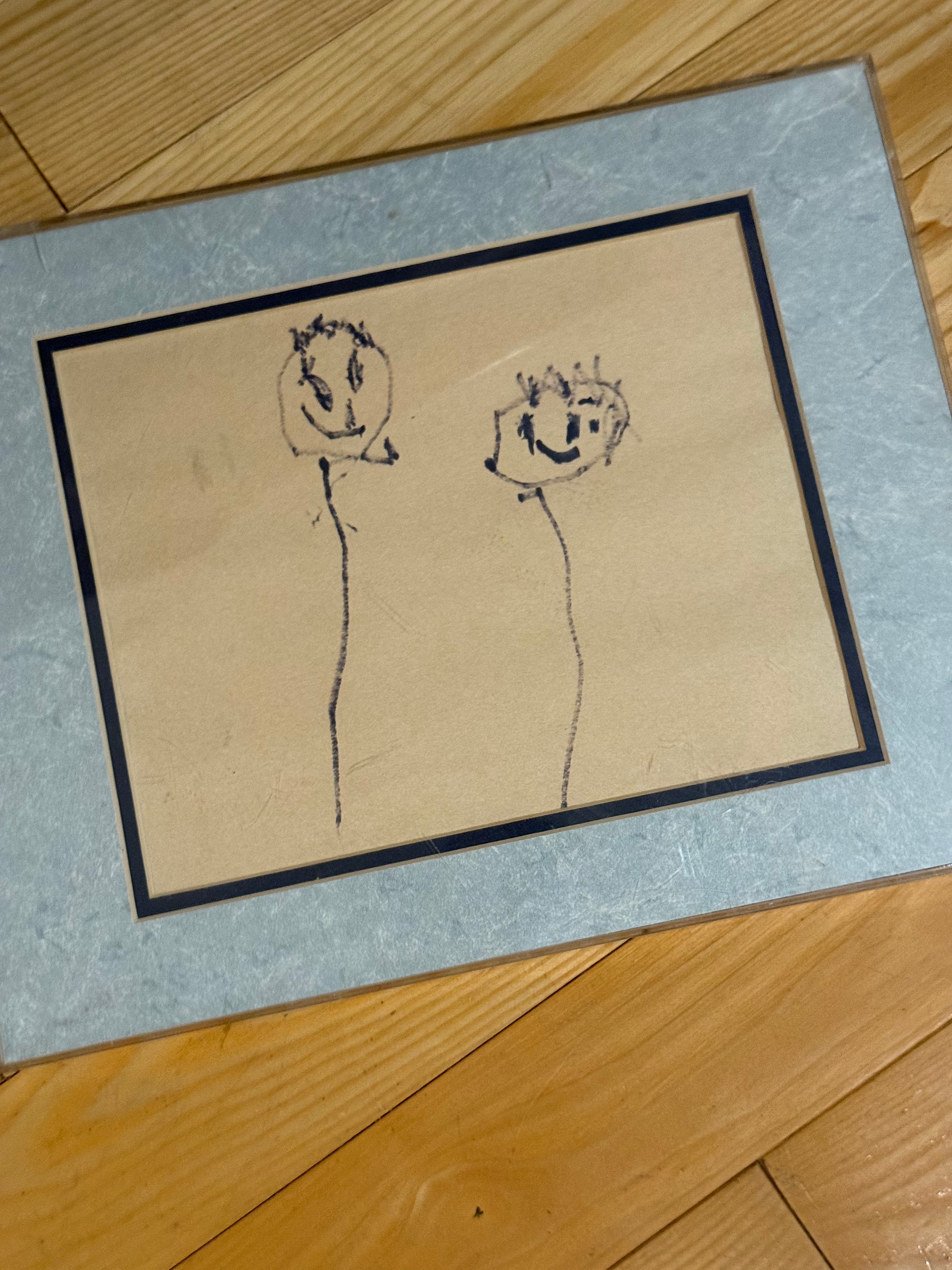
Me and Grandpa by James, Age 3
In the dream, I said I couldn’t possibly have plagiarized the painting because I only learned about the Angelus Novus after eighth grade. How could I have plagiarized something I didn’t even know about? (This argument resembles, in real life, the argument in Antiphon’s “On the Chorus Boy” which I read for a different class.) I was released of all charges but I still felt this horrible anxiety that I actually had plagiarized the painting - that everything I did was plagiarized and that someday somebody would find out.
This is all to say that apparently my classwork is really permeating my subconscious.
I really enjoyed making these reading-logs last year. They helped me process what I read (or was supposed to read) during the week and form some kind of coherent sense of everything. They help me integrate an overwhelming amount of academic information into my non-academic life. So, I think I’m going to keep making them. I want to. I know it’s cringe. I’m sorry. But I guess I want to do it and so I will. And I need the light surveillance of publication because it makes my thinking feel worthwhile. It makes me feel like I have to do a “good job.” Unsurveilled, what am I? Plus, I miss my faraway friends a lot. And this makes me feel closer to them.
Our playwriting seminar theme this semester is ‘History.’ My elective is called ‘Homicide, Revenge, & Marital Disasters: Reception of Greek Drama in Rome, England, & Japan.’ (Whatever the HELL that means, right?) I’m teaching ‘Playwriting II.'
***
First Three Weeks:
Life of Galileo by Bertolt Brecht
Light Shining in Buckinghamshire by Caryl Churchill
The Verge by Susan Glaspell
The Oresteia by Aeschylus trans. Christopher Collard
The Oresteia by Aeschylus trans. Tony Harrison
Orestes by Euripides trans. Robin Waterfield
“Visit to a Small Planet” by Elinor Fuchs
“The Bead Diagram” by Shelley Orr
“On the Concept of History” by Walter Benjamin
“On the Murder of Eratosthenes” by Lysias
“On the Chorus Boy” by Antiphon
“Against the Step Mother” by Antiphon
“Second Tetralogy” by Antiphon
“Mask and Text: The Case of Hall’s Orestia" by David Wiles
Peter Hall’s Oresteia
Ariane Mnouchkine’s Les Atrides
Kurt Vonnegut on the Shape of Stories
Marxism and Literature by Raymond Hall
[Excerpt] On the Use and Abuse of History for Life by Friedrich Nietzsche
[Excerpt] The Law in Classical Athens by Douglas M. MacDowell
[Excerpt] Early Greek Law by Michael Gagarin
[Excerpt] Brecht on Theater by Bertolt Brecht
Basically I was fighting for my life these first three weeks, reading-wise. I was dramaturging a new play workshop with José Rivera and Sara Koviak at Brown/Trinity and in rehearsal five nights a week. This meant that most of my readings of Marx and Oresteia translations happened from 10pm to the wee hours of the morning, which impacted my ability to comprehend anything. It turns out my Greek and Japanese theater class is simply a lot of reading. I guess that’s what they do over in the Classics department? I took six years of Latin in Middle and High School (the Catholic Mass was in Latin until Vatican II) but I realized pretty quickly that I didn’t retain much during our discussion of Ancient Greek and Athenian law. Things became a bit smoother once we moved into stagecraft, composition, representation, etc. I loved the Harrison translation of The Oresteia. I find the last play (The Eumenides / Orestes) particularly stirring. Most of the play is about Orestes’ being totally immobilized by guilt, which is probably the emotion I feel most terrorized by. Eventually, Orestes decides to just like revenge-kill a bunch of people and burn down the palace, which is strange because it’s kind of a shitty thing to do but you’re happy he’s out of bed. I’ve been wondering a lot about how to write for “the current moment.” How do you write something imaginative when the bullets that killed Charlie Kirk were inscribed with memes (or were they?) and that’s being used as an excuse to yet-again target trans people and to distract people from Epstein or Palestine or AI or something I don’t even know about. How do you write for a time like that? My impulse is usually to write something extreme or totally saturated in an emotional reality, but I’ve begun to wonder a bit if actually the answer is writing something more elegant and restrained and formally-structured as a kind of counter-move to the hyperreal, hypermobilized environment we’re in. Or is that just a surrender? I’m trying to figure it out in our playwriting seminar. I don’t know. I’ve been feeling emotionally disconnected from my writing. Things that are helping are being in rehearsal with José, spending time without my phone, and spending more time with people. Everything feels so unwieldily. Maybe that’s why I’ve become so obsessed with story-diagrams. I’m making my students draw their readings into some kind of structure/picture . We’re looking at Kurt Vonnegut, Shelley Orr, and Suzan-Lori Parks for inspiration how to do this.
Next Week:
Lose Your Mother by Saidiya Hartman
Wayward Lives, Beautiful Experiments by Saidiya Hartman
Fefu and Her Friends by María Irene Fornés
Noh Plays: Dodoji; Tadanori; Tomoe; Morozume; Shun'ei.
Kyogen: The Bag of Leave-Taking; The Second Class Master; The Blind Man and the Monkey; Hana-ko; The Six Shavelings; Under the Hat; The Ointment Seller; The Liquor Pipe.
“Dramaturging Non-Realism” by T. Harding-Smith
“Behind the Mask of No” by Mark J. Nearman
“Life With the No Mask” by Hisao Kanze
“Dojoji: Preparations for a Second Performance” by Reijiro Tsumara
“The Kyōgen Actor and his Relationship with the Mask” by Sengorō Shigeyama
“Some Thoughts on Kyōgen Masks” by Mansaku Nomura
Tomoe by Mikata Shizuka
Exerpt from Kuroduk
Another big week, reading-wise. I’m excited to really dive into Noh and Kyogen plays; I feel like I didn’t give those forms of theater so much attention in undergrad and I’d like to become more literate. I’ve read some Saidiya Hartman and I’m excited to jump back in. I’m really psyched to teach “Dramaturging Non-Realism.” It’s a text I go back to a lot.